
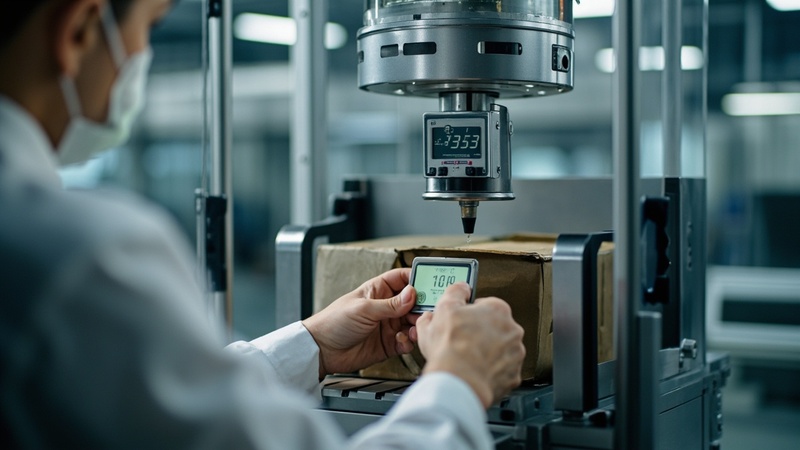
주요 내용
간단한 답변: Calibration keeps a packaging machine accurate: temperature, film tension, timing, pressure and cut position each need scheduled verification against standards.
- Five calibration domains — temperature, tension, timing/synchronization, pressure, cut position
- Temperature first for seal quality — seal strength tracks temperature accuracy
- Write a calibration protocol — frequency, method, standard, acceptance, records
- Calibration is scheduled — not an emergency activity — calendar it like maintenance
Calibration needs a theoretical baseline. Calculate the bag length and film width your product should use — then calibrate the machine to match it.
Compute your calibration baseline →서론
Achieving consistent package accuracy is not a matter of luck—it is the result of systematic calibration. Whether you are packaging pharmaceutical patches that require ±0.5 mm seal position tolerance or food bars that need consistent weight distribution, machine calibration directly determines whether your products meet specifications or end up as waste.
In our commissioning and field service work on 플로우 포장기, calibration-related issues are among the most common sources of packaging quality complaints. The good news is that most calibration procedures are straightforward when you understand the fundamentals and follow a structured approach.
This guide walks you through every critical calibration point on a horizontal flow wrapping machine, from temperature and tension systems to film tracking and product positioning. By the end, you will have a clear protocol to keep your machine producing accurate, consistent packages day after day.
핵심 요점: Proper calibration reduces material waste measurably, improves seal quality consistency, and extends the operational life of critical components.
The calibration procedures in this guide apply to horizontal flow wrappers such as the JC250 플로우 포장기.
Why Calibration Matters More Than You Think
The Real Cost of Poor Calibration
Many operators treat calibration as a “set it and forget it” task. In reality, calibration drift is continuous and cumulative. Here is what happens when calibration falls out of spec:
| Calibration Issue | Visible Symptom | Estimated Waste | Risk Level |
|---|---|---|---|
| Temperature drift | Weak or burned seals | 3-8% reject rate | 높음 |
| Tension imbalance | Crooked seals, wrinkles | 2-5% film waste | 중간 |
| Timing misalignment | Product off-center | 5-12% reject rate | Critical |
| Film tracking error | Uneven cut, registration shift | 4-10% film waste | 높음 |
| Pressure inconsistency | Intermittent seal failures | 1-4% reject rate | 중간 |
For a machine running 80 packs per minute, a 5% reject rate is about 1,920 rejected packs per 8-hour shift (80 × 60 × 8 × 5%). Even at a few cents per pack in film and product, that reject stream compounds into a serious monthly cost on a single-shift, 22-day schedule. Calibration is not just a quality measure—it is a direct cost savings strategy.
When to Calibrate
Calibration should be performed at these intervals:
- Daily: Quick verification checks (temperature display, film tracking, cut position)
- Weekly: Tension system verification, seal pressure check
- Monthly: Full calibration protocol (all systems)
- After maintenance: Any time belts, chains, sensors, or heaters are replaced
- Product changeover: When switching to different film types or product sizes
- Seasonal: Temperature and humidity changes can affect machine behavior
How Important is Temperature Calibration for Seal Quality?
What is Temperature Drift
Seal temperature is the single most critical parameter in flow wrapping. Most machines use PID-controlled heaters with thermocouple feedback. Over time, thermocouples degrade and PID parameters drift, causing the actual sealing temperature to differ from the displayed value.
A thermocouple can drift by 5-15°C over its operational lifetime. For BOPP films with a sealing range of 130-160°C, a 10°C drift can push you from a good seal to a burned one—or from adequate sealing to weak seals that fail during transport.
Step-by-Step Temperature Calibration
Tools needed: Calibrated infrared thermometer (±1°C accuracy), surface thermocouple probe, calibration log sheet.
- Pre-heat the machine to your normal operating temperature. Wait at least 30 minutes for thermal stabilization.
- Measure the actual seal bar temperature using the surface thermocouple probe at three points: left, center, and right of the seal bar. Record each reading.
- Compare actual vs. displayed temperature. If the variance exceeds ±3°C, adjustment is needed.
- Access the PID controller calibration menu (procedure varies by controller brand—Siemens, Schneider, and Delta controllers each have different access methods).
- Adjust the temperature offset to align the displayed value with the measured actual value.
- Verify at a second temperature point (at least 30°C above or below your first measurement) to confirm linearity.
- Document the results in your calibration log with date, ambient temperature, and measured values.
Pro tip from Path Pack engineers: We recommend replacing thermocouples annually as preventive maintenance. The cost of a thermocouple is negligible compared to the cost of seal quality failures.
Multi-Zone Temperature Considerations
Advanced flow wrappers often have multiple temperature zones:
- Seal bar (end seal): Typically 130-170°C depending on film type
- Longitudinal seal: May differ from end seal by 10-30°C
- Crimp jaws: Usually run cooler to avoid wrinkling
Each zone must be calibrated independently. We have seen cases where operators only checked the end seal temperature while the longitudinal seal was running 20°C below spec, causing intermittent seal failures that were extremely difficult to diagnose.
관련 항목: Configuring Packaging Speed and Output: Maximizing
Film Tension Calibration
Why Tension Calibration Is Critical
Film tension affects virtually every aspect of package quality: seal alignment, wrinkle formation, registration accuracy, and film breakage. Too much tension causes film stretching (leading to inaccurate cuts and registration drift), while too little tension causes wrinkles and tracking problems.
관련 항목: Product Changeover: Quick and Efficient Format
Measuring and Adjusting Tension
Most modern flow wrappers use dancer roll assemblies with pneumatic or electronic tension control. Here is how to calibrate:
- Set the dancer roll to its neutral position (midpoint of travel).
- Install a tension meter (or use the machine’s built-in tension display if calibrated).
- Thread the film through all guide rollers and the forming collar.
- Run the machine at production speed and measure the actual tension.
- Compare with the film supplier’s recommended tension range. Common values:
- BOPP (20-30 μm): 8-15 N
- LDPE (40-80 μm): 12-25 N
- CPP (30-50 μm): 10-20 N
- Aluminum composite: 15-30 N
- Adjust the tension regulator until the measured value falls within the recommended range.
- Verify at different machine speeds (minimum, nominal, maximum) to ensure consistent tension across the operating range.
Common pitfall: Many operators set tension by feel. While experienced operators develop good intuition, this method is not repeatable and does not transfer between team members. Always use measured values.
Tension Balance Across the Web
For wide-format machines (>300mm film width), verify that tension is uniform across the entire web width. Uneven tension causes the film to track to one side, leading to crooked seals. Use a web tension profile if your machine supports it, or adjust the roller parallelism.
What is Timing and Synchronization Calibration?
The Heart of Package Accuracy
Timing calibration ensures that the product arrives at the correct position relative to the film when the end seal and cut occur. Even a 2 mm timing error can cause:
- Crooked seals
- Product protruding from the package
- Inconsistent package length
- Film registration marks misaligned
Encoder Calibration
The rotary encoder on the main drive shaft provides the timing reference for the entire machine. If the encoder is miscalibrated, every downstream process suffers.
- Verify the encoder mounting is secure with no axial or radial play.
- Check encoder resolution settings in the PLC match the actual encoder specifications (e.g., 1000 PPR vs. 2000 PPR).
- Perform a cut-length verification: Set a target cut length of 200mm, run 10 packages, and measure each with a caliper. Calculate the average and standard deviation.
- If the average deviates by more than ±0.5mm, adjust the encoder calibration factor in the control system.
Product Infeed Timing
The product infeed timing determines where the product sits within the package. Proper calibration ensures:
- Equal margins on both sides of the product
- No product interference with seal areas
- Consistent appearance across all packages
Calibration procedure:
- Place a test product on the infeed conveyor.
- Run the machine in manual/jog mode.
- Position the film so that the cut mark is aligned with the knife.
- Jog the product forward until it is perfectly centered in the film tube.
- Note the encoder position at this point.
- Set this as the reference position for the product infeed timing.
- Run 20 test packages and verify consistent positioning.
Path Pack advantage: Our machines use Siemens servo drive systems with electronic cam profiling, allowing timing adjustments in 0.01mm increments. This level of precision is difficult to achieve with mechanically-coupled systems.
Pressure Calibration for Consistent Seal Strength
Seal Pressure Fundamentals
Seal pressure works together with temperature and dwell time to create a strong seal. The three parameters follow an interdependent relationship—changing one requires adjusting the others.
For most flow wrappers, seal pressure is controlled by:
- Spring-loaded mechanisms (basic machines)
- Pneumatic cylinders (mid-range machines)
- Servo-controlled pressure systems (high-end machines)
Calibration Procedure
- Install pressure-sensitive film (e.g., Fuji Prescale film) between the seal bars.
- Make a test seal at normal operating conditions.
- Remove the film and examine the pressure pattern. You should see:
- Uniform color across the entire seal width
- No gaps or light spots
- Symmetrical pressure distribution
- Measure seal strength using a peel test (ASTM F88 standard). Target strength depends on your application, but generally:
- Food products: 2-5 N/15mm
- Pharmaceutical: 5-10 N/15mm (per ISTA standards)
- Medical devices: 8-15 N/15mm
- Adjust pressure if seal strength falls outside the acceptable range.
- Document the pressure settings for each product/film combination.
Pressure Uniformity Check
Verify that pressure is uniform across the seal width by making multiple peel tests at different positions (left edge, center, right edge). Variance should be less than 15% across the seal width.
How Do You Handle Cut Position and Registration Calibration?
Achieving Clean Cuts
The cross-cut knife must cut at exactly the right position relative to the product and film registration mark. Misaligned cuts result in packages with uneven margins, exposed product edges, or damaged registration printing.
Calibration Steps
- Set up the photoelectric sensor to detect the registration mark on the film.
- Adjust the sensor sensitivity until it reliably detects the mark without false triggers.
- Set the cut offset in the control system so the knife fires at the correct position relative to the registration mark.
- Run 20 packages and measure the cut position relative to the registration mark.
- Verify the standard deviation is less than 0.5mm. If not, check for mechanical play in the knife assembly or excessive vibration.
Registration Mark Considerations
- Ensure registration marks are printed with sufficient contrast (typically black on white, minimum 1mm width)
- Keep the photoelectric sensor lens clean
- Check that the film guide rollers do not cause the film to weave, which can affect sensor detection
Creating Your Calibration Protocol
Documentation Is Essential
A proper calibration protocol includes:
- Calibration checklist with all measurement points
- Acceptable ranges for each parameter
- Measurement tools required and their calibration status
- Step-by-step procedures for each calibration task
- Recording sheets for documenting results
- Corrective action triggers (what to do when a parameter is out of spec)
- Calibration schedule with assigned responsibilities
Recommended Tools
| Tool | Accuracy Required | Typical Cost | Calibration Interval |
|---|---|---|---|
| Infrared thermometer | ±1°C | 낮음 | 매년 |
| Surface thermocouple | ±0.5°C | 낮음 | 매년 |
| Tension meter | ±0.5 N | Moderate | 매년 |
| Digital caliper | ±0.01mm | 낮음 | 매년 |
| Pressure-sensitive film | N/A | Low, per pack | N/A |
| Peel test fixture | ±0.1 N | Moderate to high | 매년 |
Calibrate Against Theory, Not Guesswork
Accuracy work starts with knowing what the correct values are. The free calculator produces your theoretical film width and bag length from product size or fill weight — the baseline your calibration should converge on.
- ✓ Theoretical film width & bag length
- ✓ Baseline for seal and cut-off alignment
- ✓ Density reference for powder products
- ✓ Free tool, instant result
자주 묻는 질문
How often should I calibrate my flow wrapping machine?
At minimum, perform a full calibration monthly. However, daily verification checks (temperature, cut position, film tracking) should be part of your startup routine. After any maintenance intervention, recalibrate affected systems before returning to production.
What is the most common calibration mistake?
The most common mistake is only checking one parameter (usually temperature) while ignoring tension and timing. These three systems are interconnected—a temperature issue may actually be caused by incorrect dwell time from a timing problem. Always check all systems holistically.
Can I calibrate the machine myself, or do I need a specialist?
Basic calibration (temperature offset, cut position, film tracking) can be performed by trained operators. However, encoder calibration, PID tuning, and servo system adjustments should be performed by qualified technicians. At Path Pack, we provide thorough training so your team can handle routine calibration independently.
How do I know if my calibration tools are accurate?
All measurement tools should be traceable to national standards (NIST in the US, PTB in Germany, NIM in China). Have your tools calibrated annually by an accredited laboratory. Keep calibration certificates on file for quality audits.
What should I do if calibration values keep drifting?
Recurring drift usually indicates an underlying issue: worn bearings causing vibration, degraded thermocouples, loose mechanical connections, or electronic component aging. If drift exceeds acceptable limits between scheduled calibrations, investigate the root cause rather than simply recalibrating.
결론
Machine calibration is not a one-time setup task—it is an ongoing discipline that directly impacts your product quality, material costs, and equipment longevity. The key points to remember:
- Temperature calibration should be verified with actual measurements, not just display values
- Film tension must be measured objectively and matched to your specific film type
- Timing and synchronization require precision adjustments and regular verification
- Seal pressure must be uniform and documented for each product-film combination
- 문서 transforms calibration from an art into a repeatable, auditable process
Investing time in a structured calibration protocol pays for itself through reduced waste, fewer quality complaints, and more consistent production output. Path Pack machines are engineered with Siemens and Schneider components that maintain calibration stability.
If you are experiencing accuracy issues with your current packaging line, or if you are evaluating new equipment for your facility, our engineering team can provide a detailed assessment. Contact Path Pack today to discuss your packaging accuracy requirements.
Path Pack 기술팀 제공
🛠️ 실전 가이드: 사용 중인 기기에 대한 단계별 지침은 다음을 참조하십시오. Calibrating Your Machine 에서 Path Pack 지원 센터.


 English
 Spanish
 French
 German
 Korean
 Russian
 Italian
 Arabic